
DISC Behavioural Profiles for Workplaces and Leadership Clarity
Understanding behavioural style, communication preferences, and responses under pressure.
DISC behavioural profiles provide structured insight into how people tend to communicate, make decisions, and respond to challenge at work. As a workplace personality profile, DISC focuses on observable behaviour rather than traits, values, or capability.
Used well, DISC creates shared language and awareness.
Used poorly, it creates labels and false certainty.
This page explains what a DISC personality profile is useful for, where its limits sit, and how DISC assessments should be used responsibly in professional settings.

What a DISC Personality Profile Helps With
A DISC assessment helps individuals and teams understand behavioural preferences at work, including:
How someone tends to communicate.
How quickly they make decisions.
How they respond to structure, change, and challenge.
How behaviour may shift under pressure.
As a behavioural personality profile, DISC provides a neutral reference point for discussing differences in style without attributing intent, motivation, or capability.
Used appropriately, DISC supports awareness and dialogue rather than judgement.


Common Problems With DISC Profiles In Organisations
DISC profiles are frequently misapplied in ways that reduce their value and increase organisational risk.
Common misuses include:
Treating DISC profiles as fixed traits rather than behavioural tendencies
Using labels to explain behaviour instead of exploring context
Assuming behaviour remains consistent under pressure
Applying DISC without translating insight into real situations
When this happens, DISC can oversimplify complex dynamics and obscure what is actually happening between people.
Why a DISC Report Alone Is Rarely Enough
A DISC report describes behavioural tendencies. It does not explain how those tendencies show up in specific situations, particularly when expectations rise or pressure increases.
Without interpretation:
Behaviour can be misread.
Impact can be confused with intent.
Stress responses can be mistaken for personality.
Conversations become reductive rather than useful.
Interpretation translates a DISC personality assessment into practical understanding, grounded in real scenarios rather than theory.
Interpretation provides the context needed to apply DISC responsibly in real workplace situations.
When a DISC Assessment Is The Right Tool
DISC is appropriate when:
You want a shared language for behavioural differences.
You are exploring communication or working style.
You need a low-risk psychometric assessment for work.
You are working at an individual or team level.
DISC is not sufficient when:
Behavioural issues are systemic.
Patterns escalate under pressure.
Accountability or trust is breaking down across teams.
In these situations, broader diagnostic work is usually required.
How DISC Profiles Are Provided On This Site
DISC behavioural profiles are provided as a structured input, not a conclusion.
Profiles are completed individually and confidentially.
Reports are provided digitally.
Interpretation is strongly recommended to reduce misinterpretation and misuse.
Clear boundaries are maintained around what DISC can and cannot explain.
DISC is treated as a lens for enquiry, not an answer in itself.


DISC Profile Interpretation For Responsible Use (Recommended)
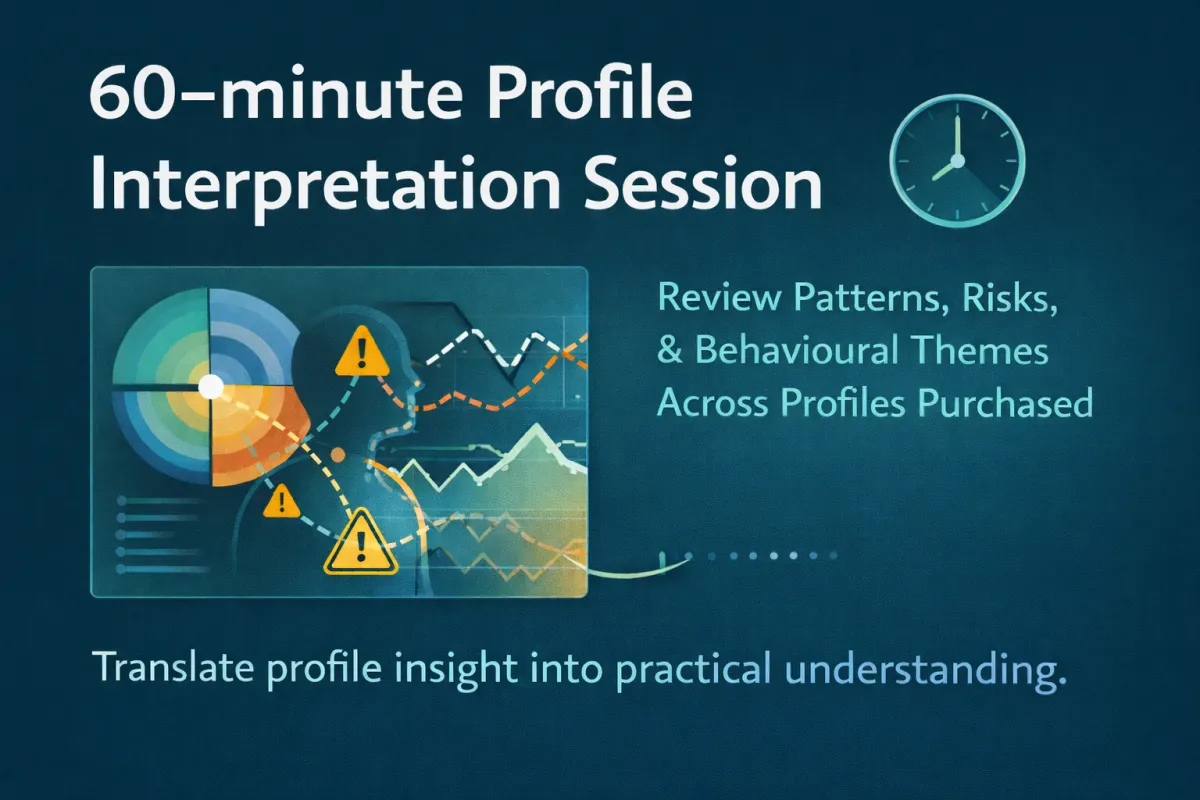
The optional interpretation session focuses on translating your DISC profile into practical, work-relevant insight.
Rather than revisiting DISC theory, the session explores:
How your behaviour is likely experienced by others.
How it tends to shift under pressure.
Where small adjustments may reduce friction or confusion.
How to apply insight to current situations.
The session is confidential, time-bound, and conducted online. It is designed to support clarity, not to coach or evaluate performance.
Who Typically Uses DISC Profiles
DISC personality profiles are commonly used by:
Individual leaders seeking greater self-awareness at work.
Managers wanting to improve communication.
HR teams exploring behavioural patterns.
Organisations preparing for further diagnostic or decision-making work.
They are most effective when used thoughtfully and proportionately.
Choosing Between DISC and SDI
DISC and SDI answer different questions. Choosing the right starting point depends on what you are trying to understand.
DISC focuses on observable behavioural style — how people communicate, work, and make decisions.
SDI focuses on underlying motivation and conflict dynamics — why behaviour changes when pressure increases.
Neither is better. Each is useful in different situations.
DISC is often the right starting point when:
DISC is often the right starting point when:
Communication styles or working preferences are causing friction.
Differences feel situational rather than personal.
You want shared language without adding complexity.
You are exploring behaviour at an individual or team level.
DISC works well as a low-risk entry point for understanding behavioural differences at work.
A simple way to decide:
If the question is “How do people differ in how they work?” → start with DISC.
If the question is “Why does behaviour change when things get difficult?” → start with SDI.
If neither question fits cleanly, a short conversation can help sense-check suitability before choosing.
Next Step
If DISC is an appropriate starting point for your situation, profiles can be purchased below. Interpretation is strongly recommended to ensure insight is applied responsibly.
If you’re unsure whether DISC or SDI is the right starting point, you’re welcome to arrange a short conversation to sense-check suitability.
DISC profiles are issued manually. Once your purchase is complete, you will receive your assessment link within 48 hours.
In most cases, this is issued much sooner, often within a few hours, but the 48-hour window allows for availability and ensures accurate setup.
Final Note
A responsible use of DISC:
DISC is a useful tool when applied with judgement. It is not a diagnostic in itself, and it should not be expected to explain everything.
Used responsibly, a DISC profile creates clarity.
Used indiscriminately, it creates noise.

DISC FAQs
1. What is DISC, in practical terms?
DISC is a behavioural assessment that looks at how people tend to communicate, work, and respond to challenge. It focuses on observable behaviour, not personality, values, or capability.
2. Is DISC a personality test?
No. DISC describes behavioural tendencies, not who someone “is”. It does not measure intelligence, competence, potential, or suitability for a role.
3. Are there right or wrong DISC results?
No. There are no good or bad profiles. Each style has strengths and limitations depending on context and expectations.
4. Do DISC styles change over time?
Behavioural preferences are generally stable, but behaviour does shift in response to context, role demands, and pressure. DISC reflects tendencies, not fixed traits.
5. What does DISC show about behaviour under pressure?
DISC can highlight how behaviour may intensify or narrow when pressure increases. Interpretation is important here, as stress behaviour is often misread without context.
6. Can DISC be used for recruitment or selection?
The short answer is yes, it can, but DISC should not be used as a standalone tool for hiring, promotion, or performance decisions. It is most appropriate for development, communication, and awareness.
7. What if someone disagrees with their DISC profile?
That’s not unusual. A profile is a starting point for discussion, not a verdict. Interpretation helps explore where the insight fits, and where it doesn’t.
8. Why isn’t the report enough on its own?
A report describes tendencies. It does not explain how those tendencies are currently showing up at work, especially under pressure. Interpretation helps translate insight into practical understanding.
9. How do you avoid DISC becoming labels or stereotypes?
By treating it as a lens, not a label. DISC should support conversations about behaviour, not excuse it or replace accountability.
10. Who sees the results?
Profiles are completed individually and treated as confidential. Sharing is a choice, not a requirement, unless agreed otherwise within an organisational context.
11. How reliable is DISC?
DISC is a long-established behavioural framework when used appropriately. Like all psychometric tools, its value depends on quality of administration and interpretation.
12. How do we know if DISC is the right starting point?
DISC is usually appropriate when the focus is on communication, working style, or behavioural differences. If behaviour shifts sharply under pressure or conflict is escalating, SDI may be more suitable.



© One Degree Training & Coaching Ltd 2022-2026
Company No: 14053252 | VAT Reg No: GB 428 995 340
One Degree Training & Coaching Ltd is registered in The United Kingdom at One the Brayford, 20 Brayford Wharf North, LINCOLN, Lincolnshire, LN1 1BN