
Leadership Behaviour Under Pressure | Why Models Fail
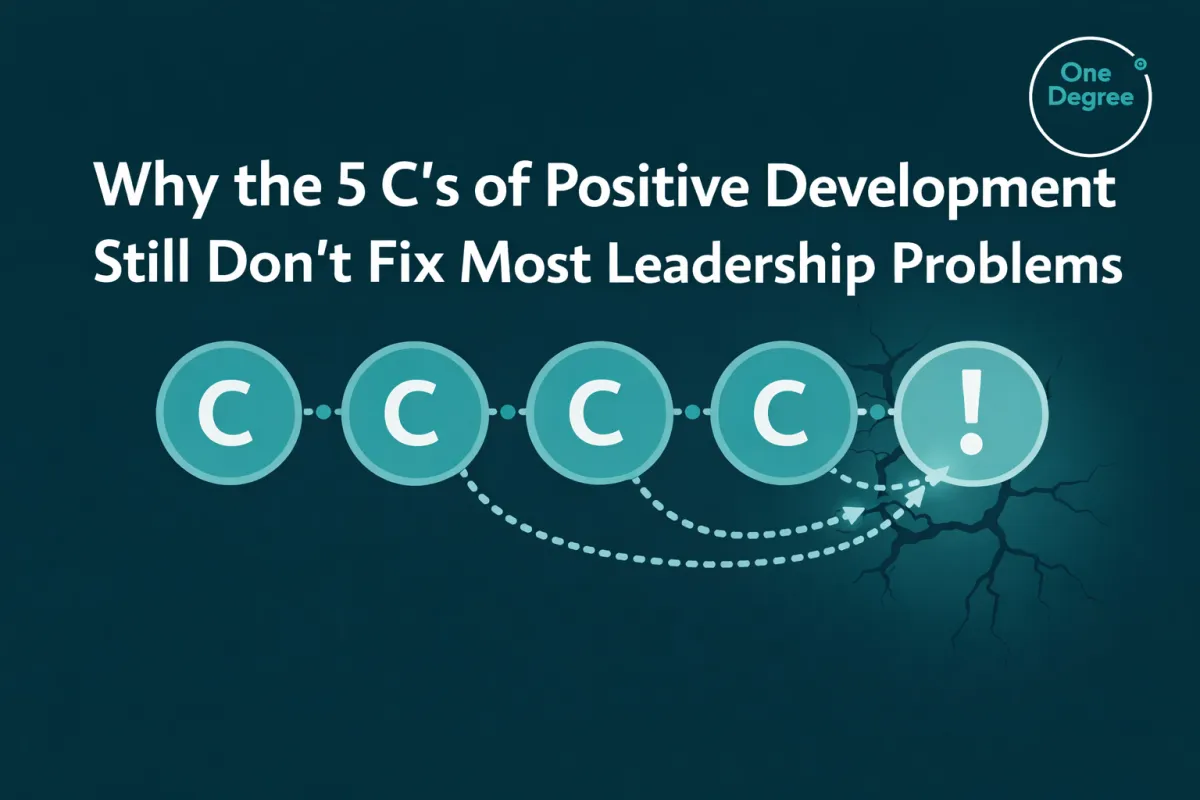
Why the 5 C’s of Positive Development Still Don’t Fix Most Leadership Problems
Leadership development has a long-standing preference for tidy models. Clear labels, simple structures, and memorable frameworks offer organisations a sense of progress and reassurance that leadership issues are being addressed.
Richard Lerner’s 5 C’s of Positive Development are a good example. Competence, confidence, connection, character, and caring. In some versions, a sixth “C” is added. Each element is sensible. None are controversial.
And yet, many organisations that adopt frameworks like this still experience the same leadership problems, particularly when pressure increases: miscommunication, avoidance of accountability, strained relationships, and teams that struggle to function when situations become uncomfortable.
The issue is not the model itself.
It is how leadership models are relied on when leadership behaviour is tested under real conditions.
When leadership frameworks meet pressure
Most organisations already operate with no shortage of leadership frameworks. What is often missing is the ability to interpret those frameworks in the middle of complexity, pressure, and human dynamics.
This gap becomes visible when:
performance conversations become uncomfortable.
teams stop challenging one another.
confidence drops under scrutiny.
caring leadership unintentionally weakens accountability.
At this point, knowing the language of a leadership model is not enough.
Leadership effectiveness depends far less on remembering concepts and far more on recognising what is actually happening in the team, particularly when behaviour shifts under pressure.
This is where many leadership development initiatives quietly fail.
Why leadership models fall short in practice
Frameworks are tools. They rely on judgement.
A leader can understand a model perfectly and still misread the behaviour unfolding in front of them. When this happens, theory is applied without context, and well-intentioned actions often produce unintended consequences.
From an HR perspective, this is often where issues begin to escalate. Managers believe they are acting in line with organisational values, while teams experience inconsistency, avoidance, or a lack of clarity.
The challenge is rarely a lack of leadership knowledge.
It is a lack of behavioural awareness under pressure, particularly when accountability becomes uncomfortable.
This helps explain why leadership initiatives can feel inconsistent in their impact, even when the underlying model itself is sound.
Where the 5 C’s still add value
Used as a reflective lens rather than a checklist, the 5 C’s can surface important patterns in leadership behaviour:
where confidence drops when scrutiny increases.
where connection weakens across functions.
where responsibility is avoided or unevenly held.
where caring behaviour unintentionally removes clarity.
where competence is undermined by unclear expectations.
The model helps identify what might be happening.
It does not explain why behaviour shifts under pressure, or how leaders should adapt their response when accountability, trust, or performance begins to wobble.
That requires a deeper understanding of behavioural patterns, personality differences, motivational drivers, and the pressures shaping behaviour within the system.
What actually shifts leadership effectiveness
Sustainable leadership performance is not driven by adopting better frameworks. It comes from improving behavioural predictability, clarity of expectations, and leaders’ ability to adapt how they show up based on context.
Organisations that perform well under pressure tend to share three characteristics:
Leaders understand how their behaviour is experienced, not just how it is intended.
Teams have clear, shared expectations about behaviour when situations become difficult.
Accountability is supported by awareness and clarity, not enforced through escalation.
When these conditions are present, leadership models become useful tools rather than abstract ideals.
This is also where organisations tend to see fewer issues escalating unnecessarily.
A question worth considering
For organisations using leadership frameworks such as the 5 C’s, a more useful question may be this:
Where are we relying on leadership intent and values, rather than shared behavioural expectations, when pressure increases?
That distinction often explains why some leadership initiatives stabilise behaviour, while others result in the same problems being experienced and escalated in a different language.